
In short – yes.
Here’s the long answer:
Logically, if someone were to be aware of the immense, divine love and the true nature of who/what we are – surely they’d be at peace all the time? If they knew how powerful they truly were, that they were not just connected to source, but an extension of it, they’d feel super confident in every situation? Well, not necessarily.
Spiritual enlightenment is often misunderstood – thought of as a one-time event or final state of being. It’s actually a process, where someone gradually has deeper understandings of themselves, and how the universe ‘works.’
When I talk about dysregulation, I mean nervous system dysregulation.
Our nervous systems are designed for survival. One of its many roles is to protect us by making assumptions about the future based off past experiences.
A few thousand years ago, this would mean being cautious of exploring new places because of a potential bear attack. But in modern times we don’t have a bear down the street, we have a Starbucks.
Despite this, our systems are still wired for survival the same way. Anything perceived as unknown is viewed as dangerous and kept at arm’s length until taught otherwise.
In other words, our nervous system likes what’s known or ‘how things are,’ because this means it can prepare for what might happen in the future and allows us a sense of safety. This is why getting out of your comfort zone or trying something new can be terrifying at times, because you don’t fully know how to prepare for it or know if it’s safe until you’ve done the thing.
The Side Effects
In a world of hustle and social media, it can be easy to get swept into this stressed and panicked mindset of ‘I need to get there faster.’ When has that done any good? In states of heightened emotion, it’s so much harder to think clearly, and see what to do or where to go.
When you slow down, you have an opportunity to see other courses of action, rather than having tunnel vision on the one you are trying to force. Spiritual advancement is no different.
The ‘unknown’ doesn’t have to just be physical places or people, it also includes new understandings about the universe (as mentioned above), which can be learnt through texts, teachings, and certain practices like meditation.
Partaking in regular spiritual practices is by no means negative, but if they’re intense and there’s no grounding – or time for integration – you can quickly start to experience symptoms such as:
- Headaches
- Dizziness
- Fatigue
- ‘High’ but out of control
- Dissociation or depersonalisation
- Anxiety or panic
- Mood swings
- Feeling on top of the world followed by collapse
(Notice how this sounds very similar to kundalini syndrome, or zen sickness?)
These are autonomic nervous system responses, specifically extreme fluctuations between the sympathetic and parasympathetic systems.
They are physical responses to a system that is overwhelmed with the information it’s receiving. It cannot process quickly enough to re-orientate and establish ‘how things are,’ and therefore what to base its predictions on.
When Awareness and Regulation Don’t Match
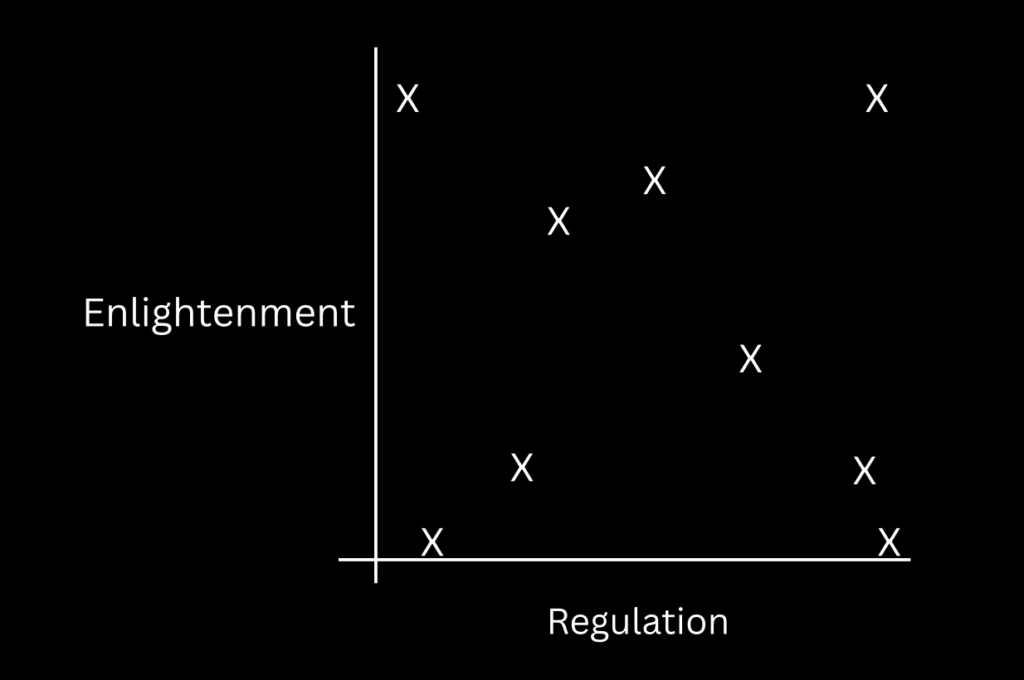
For those who prefer visuals, the graph above shows two different aspects of experience.
The vertical axis represents spiritual insight/enlightenment, and the horizontal represents nervous system regulation.
Where someone sits on the graph shapes how they experience reality. (These are not set points, just examples of where someone might be on it).
Someone with a well-regulated nervous system can be grounded, emotionally resilient, and outwardly successful (however success looks to them) but not have any faith or spiritual beliefs at all. Their system has learnt that things like money, visibility, challenge, or change are generally safe. When they do become triggered, or their nervous system is activated, they can return to baseline pretty easily.
On the other hand, someone can have profound spiritual insight and still struggle with the symptoms mentioned previously. Heightened sensitivity (whether experienced as intuition, psychic, channelling, seeing auras, or something else) reflects open perceptual gates. But if the nervous system hasn’t developed the capacity to contain and regulate that level of input – especially if each insight hasn’t been fully processed before the next one comes in – it can become overwhelming rather than stabilising.
The Good News and Solution
After a while you’ll likely find you can withstand greater insights and integrate them more easily, allowing for larger shifts in perspectives or ‘jumps’ in enlightenment over time.
However, this comes from how safe the nervous system feels at each stage. If you try and race ahead it will completely backfire on you.
Safety is built through gradual exposure – taking smaller steps and integrating them fully first, so the nervous system learns that each new insight is survivable. As the evidence for each perspective builds, the system relies less on old threat patterns and more on lived safety, allowing for greater leaps in consciousness to happen.
This is where somatic practices like EFT work wonders. Tapping on meridian points throughout the body is a safety signal. These signals are sent to structures like your amygdala (the part of your brain responsible for emotional processing), allowing your system to – gently but surely – update its response to the world and the input it receives.
Other ways to help develop nervous system capacity include:
- getting enough quality sleep
- eating a healthy diet
- reducing and managing stress (EFT can help with that as well)
- mindfulness and slowing down
- getting outside in nature – without your phone.
- exercise
- grounding – visualisation, getting outside, crystals etc.
- breathwork
Takeaways
Whilst spiritual insights are often sudden, nervous system regulation is a slower process through repetition and learning that the new insight is safe to embody.
None of what I’ve spoken about today is to scare you or derail you from starting or continuing your spiritual practice. It’s to take both aspects of existence into consideration; yes, we are spiritual beings, and yes, incredible feats can be accomplished through thought and intention – but we are still human.
Something like a 15-minute EFT session or 10 minutes of breathwork can be enough to help calm the nervous system, so allowing the physical body to catch up doesn’t have to take a long time – but it’s important to do so. Otherwise, you’ll become overwhelmed, and struggle to live out the insights received.
I hope this post was helpful to those seeking answers. Be kind to yourself, and know you are not alone in figuring things out.
Any questions or queries feel free to send me an email.
Much love,
Darcey